The best protection against injuries

Backbending, March 2023
The best protection against injury is to practice every day. You know your limits and can go beyond them. But because you know your limit, you also feel when you are going too far. When you practice daily, you know that the process is just as important as the goal. Phrases like 'splits in 30 days' are great promises. Some may succeed. But if you force your body into asanas too quickly, you risk injury. And then what happens when the 30 days are up and you have learned the splits? Then comes the next goal. Goals are always just intermediate goals. Learning happens between two goals.
Situations that make injuries more likely:
1. breaks that are too long. The mind still has stored what was possible. But the body has already adapted to another way of life, has become more inflexible and weaker.
2. practicing in groups also carries a greater risk of getting injured. Whether you like it or not the group dynamic has an influence on practicing. There is a different energy in groups. Positive competition often makes you rise above yourself. But sometimes that is too much.
3. being too ambitious can also be counterproductive. One must always be attentive. Being patient is a skill that can be learned.
Next weekend I will attend a workshop. The teacher is a contortionist. The course lasts four hours. Two hours are devoted to leg work, two hours to the back. That's a lot. The best preparation is to practice every day until the course (and after, of course). This insight also made it easy for me to start my yoga week today. Injuries always mean frustration and regression.
To the picture:
It shows a backbend. The hip flexors are stretched and also the upper body. Exercises to learn the splits overlap with the exercises for the backbends.
The other day I had the idea to use a box of water as an aid. With the pillow I used as a base, it worked well.
Translated with www.DeepL.com/Translator (free version)
Ashtanga and the splits


The splits are introduced very early in the Ashtanga yoga series. Utthita hasta padangusthasana and Utthita parsvasahita are splits. There is one more difficulty added to this stretch, that is the balance that must be maintained in all standing postures. First and foremost, the postures shown above are balance exercises. Then comes the stretching exercise of the legs.
To improve the stretch, I practice the splits (hanumanasana and samakonasana) before these standing postures.
How to keep the balance?
1. only one foot is on the floor. The toes must hold on to the floor. The toes can become like claws.
2. the knee is pushed through. I learned that very late. I always thought it was better to keep the leg slightly bent to balance if you were in danger of falling over. But my experience is that you stand more stable when the knee is bent,
3. the abdominal muscles and the pelvic floor are tense.
4. the breathing is even.
5. the eyes are fixed on one point. It is better to look straight ahead than at the floor.
6) The elbows help with balancing. If the leg is extended forward, the elbow is pulled back. If the leg is extended to the right or left side, the elbow points to the other side. This seems to be only a small thing, but in total these small things decide whether you fall out of the asana or are well balanced.
7. the last point I would call 'balance of forces'. In utthita hasta padangusthasana, the hip pulls down, the foot is pulled up with the help of the arm. When both forces are equal, this brings balance. It is similar with utthita parsvasahita. The hip moves forward with the same force as the foot moves backward with the help of the arm. This also prevents the hip from moving backward.
In utthita hasta padangusthasana, my upper body remains upright. I try to move the leg to the upper body and not the other way around. My sacroiliac joint injury did not allow me to bend forward in this way for a long time. I then stayed with my variation, as a precaution.
Some postures prepare the body for what will be practiced years later. The splits are part of the 3rd and 4th or Advanced A and B series.
Breaks are part of it. They support the exercises. Tomorrow is my day off.
Translated with www.DeepL.com/Translator (free version)
Active versus passive stretching
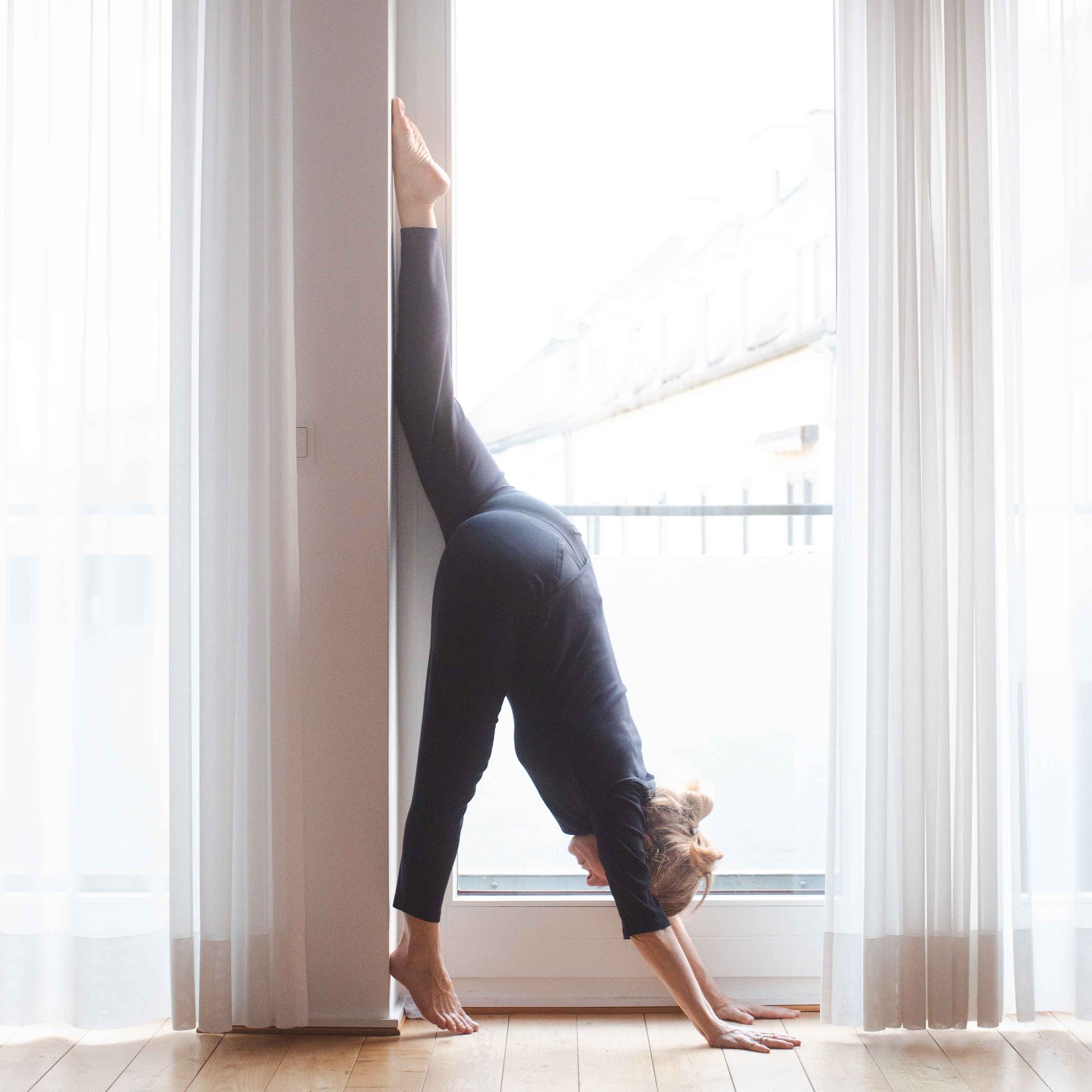
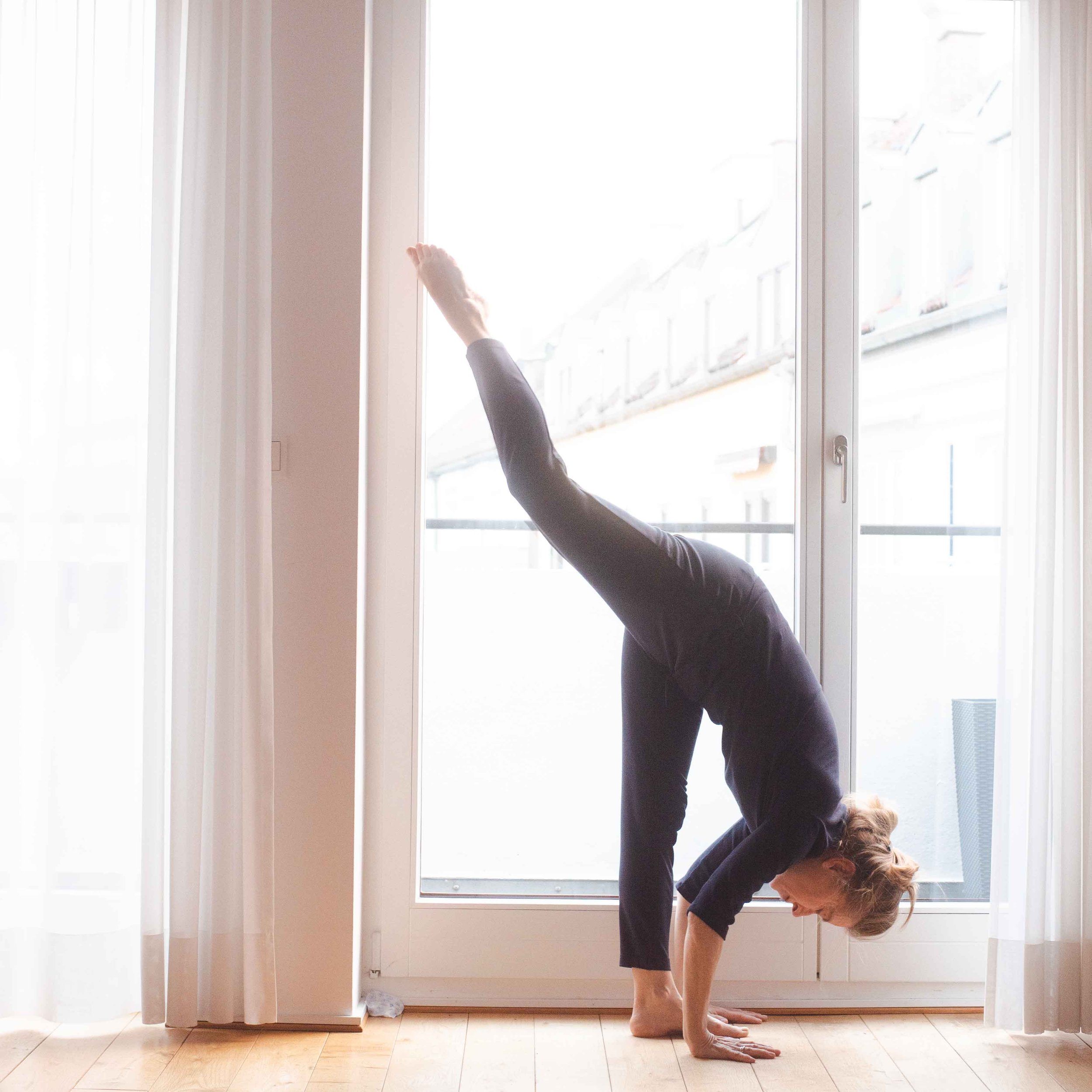
Passive stretching is done with the help of external forces. In the picture on the left, it is the wall. The resistance allows me to go much deeper into the position. In the picture on the right (active stretching) you can see the difference.
Active stretching can also be done dynamically by swinging the leg upwards. Active stretching can also be practiced statically. For many positions it is a good idea to start with dynamic stretching. Afterwards you can hold the position (static stretching).
The pose on the right is often called needle pose. I have photographed it here only to show the difference. The pose is not part of my daily program.
I really like practicing the splits against the wall. You literally fly because your foot often lifts off the floor when you press your body against the wall. The position also strengthens the arms.
You pick a position you want to learn and along the way you get to know the position better and better. You learn how the joints work. You learn different stretching techniques (dynamic, static, active, passive). And you learn patience. Overeagerness often leads to injury and that always means a setback.
I think it's a good idea to hold the splits not just for one minute, but two minutes, three minutes to eventually 5 minutes.
Even today the beginning was hard. Once the first sun salutations were practiced, everything went great. Now I am looking forward to my exercise tomorrow morning.
Experiment.
Go on a journey of discovery.
Translated with www.DeepL.com/Translator (free version)
Hanumanasana
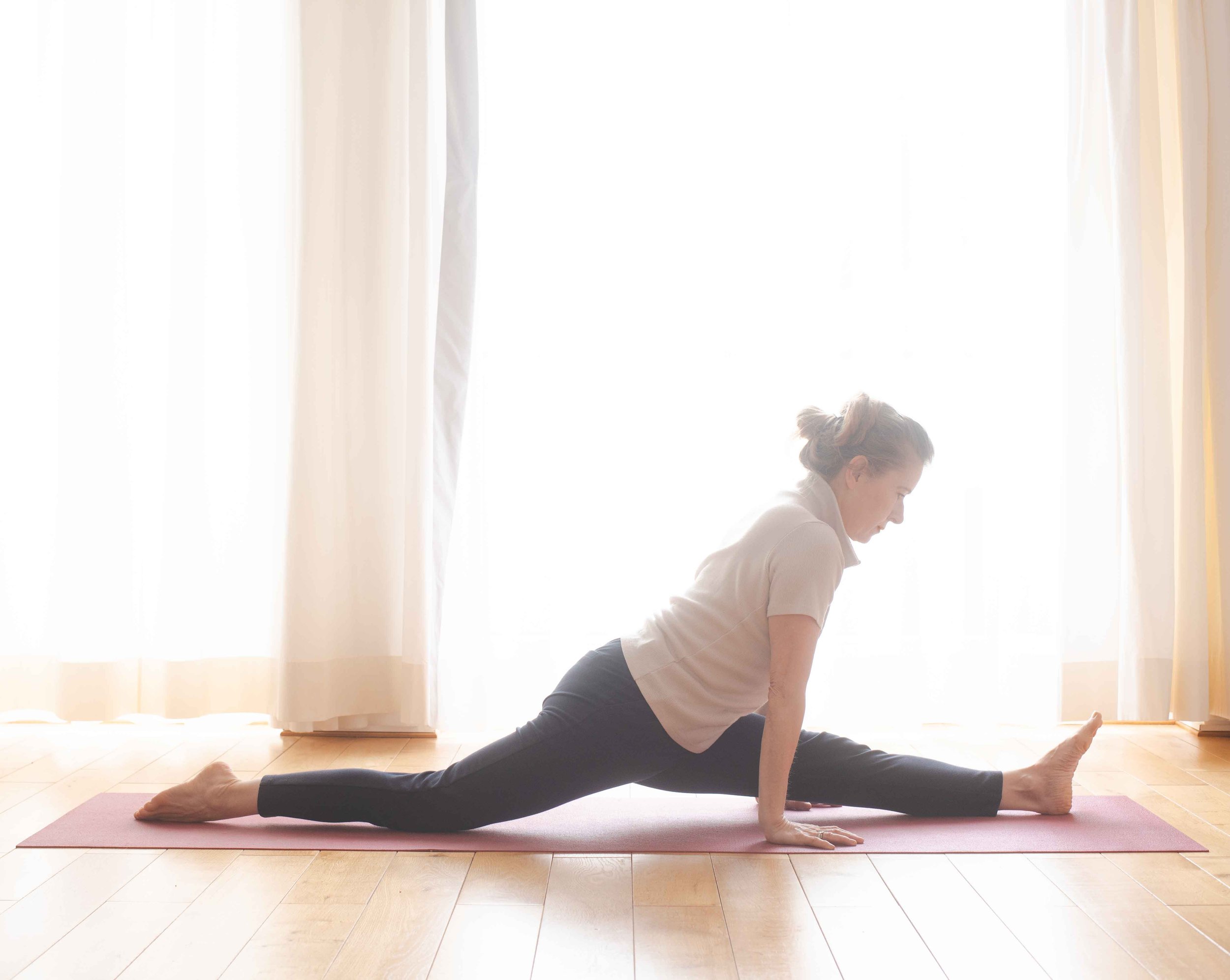
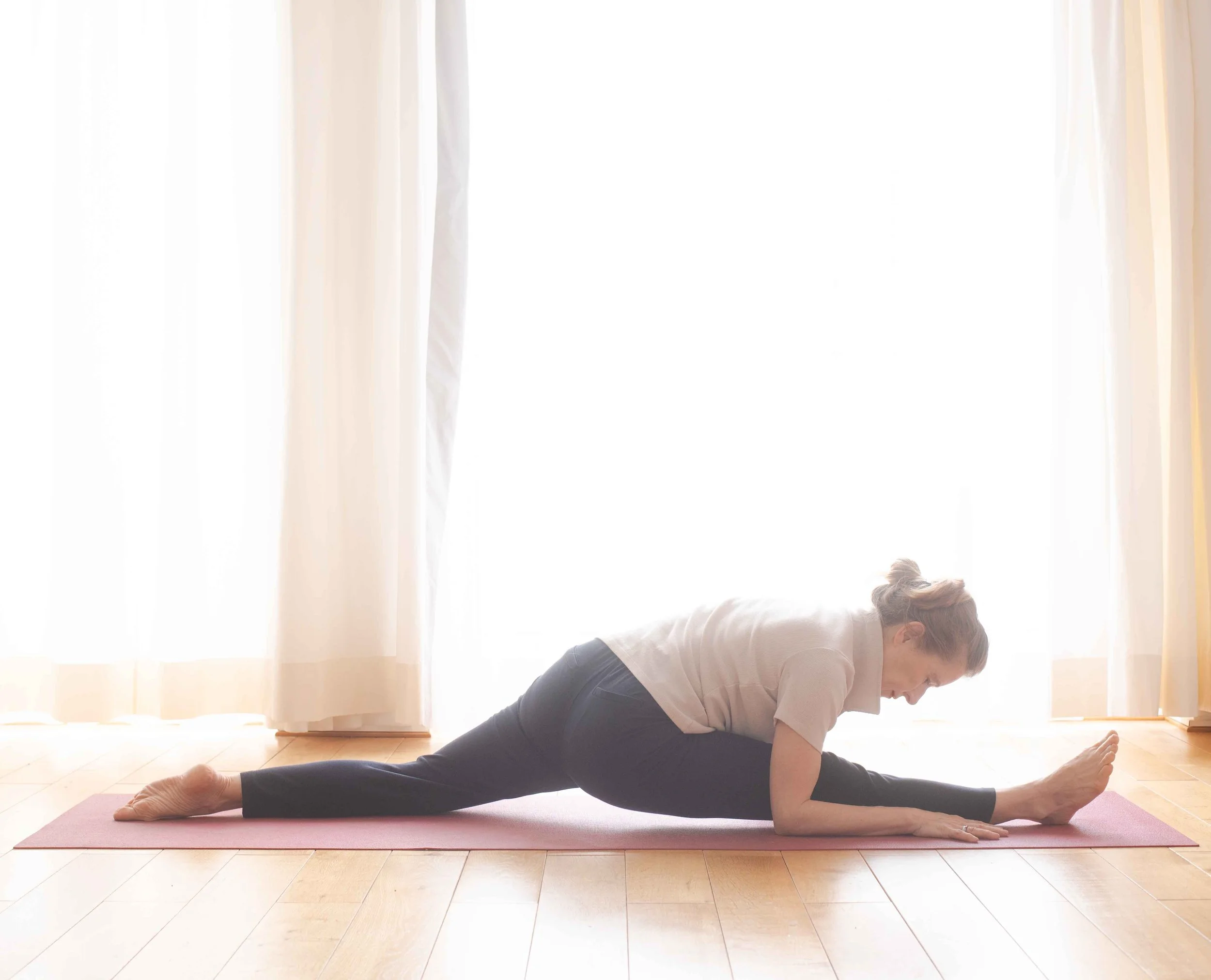

In the first picture I am practicing hanumanasana without blocks. The upper body is tilted forward. So the stretch of the hip flexor decreases. Instead, the hamstrings are stretched. The more upright the upper body is, the more the hip flexor is stretched.
The classic form of hanumansana has the upper body resting on the front leg.
There are many variations of hanumansana. You will certainly not get bored.
My first intermediate goal is to bring the front extended leg to the floor.
The leg muscles are tense during the exercise. The energy moves to the center of the body. The legs are not moving away from the body, but toward the center of the body.
I hold the position for one minute, then switch sides. It is definitely helpful to hold the position for two, three and maybe even up to 5 minutes. Yesterday I learned from a man who wanted to learn the splits within 30 days, that he held the stretch 10 minutes.
I prefer repetitions to very long holds.
Holding a position and repetitions are effective methods, which already have general validity.
I just looked up the word 'hamstrings'. I only knew the English word. Hamstrings means back thigh muscles ( rückseitige Oberschenkelmuskulatur) in German. I prefer the word 'hamstrings' in German as well. It’s so much shorter.
Keep practicing, keep learning.
Translated with www.DeepL.com/Translator (free version)
Split stretches


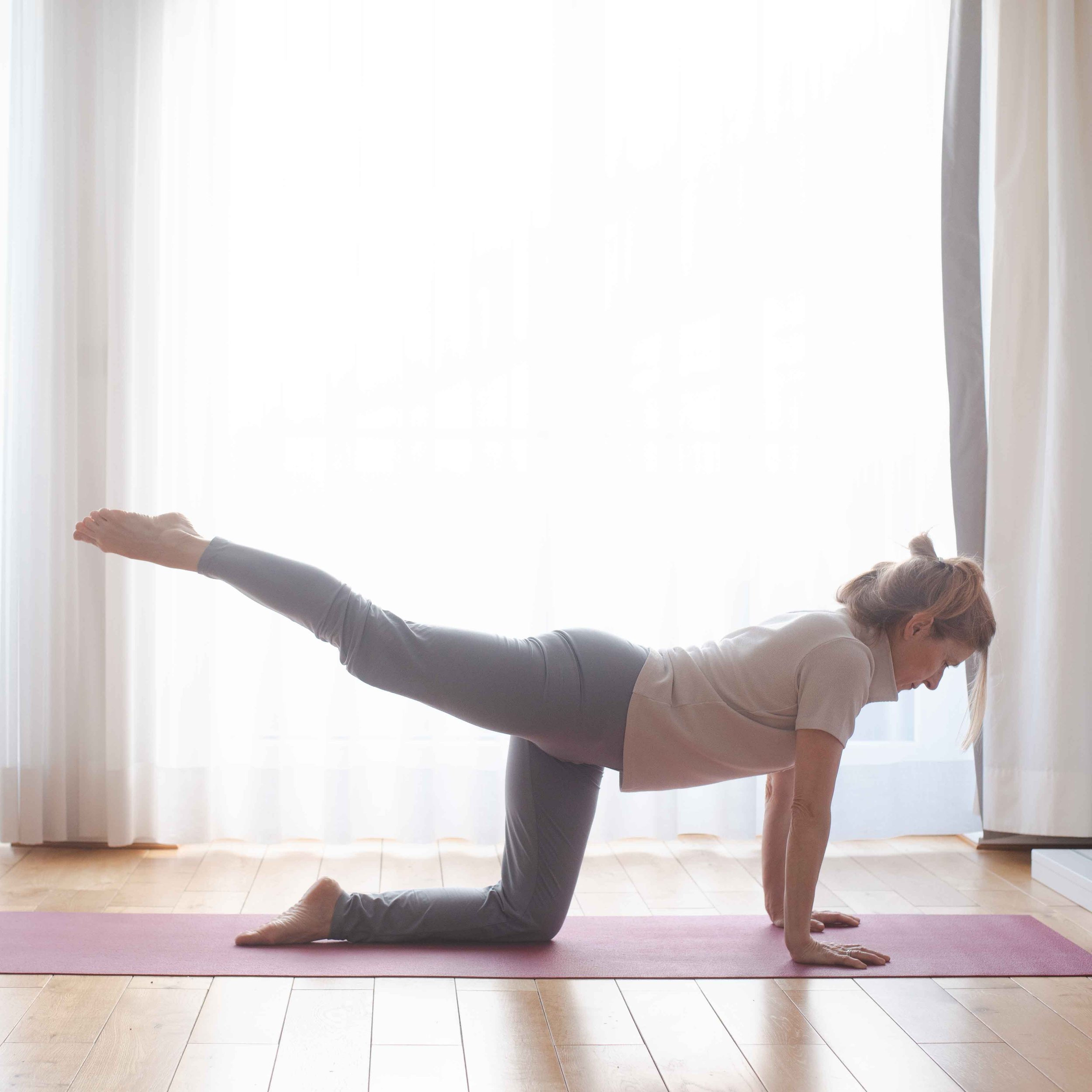

The pictures are taken in March 2023
Any position that stretches the thigh, hip flexor or hamstrings is a forward splits exercise.
There are many positions that target individual body parts. Picture one shows how I stretch the thigh. The knee is almost against the wall, the leg is bent. The foot and the upper body press against the wall. You can clearly feel the stretch in the thigh.
In the second exercise, both thighs are stretched at the same time.
In picture three you can see an exercise that actively stretches the hip flexor.
Picture four shows the splits while lying down. Since gravity does not push the body against the floor, if you are lying on your back, you can only support the position with the strength of your arm.
Some days it is sufficient to perform exercises more simply. Not always you have enough energy to face the demanding positions. The most important thing is to keep at it.
Not every day shows progress. It will bring something, I think to myself sometimes. In a few weeks you will see, if this is true. If it doesn't work, you can plan other exercises. Nothing has to be fixed forever. In this respect, I'm moving away from the default in the Ashtanga yoga community, which is to practice the prescribed asanas, come what may. I had to become more flexible. The reason was my sacroiliac injury almost 7 years ago. I had to become much more attentive to my body. I had to find solutions on how to keep practicing. This included being more flexible with yoga sequences.
What is possible today, I ask myself.
You have to feel when you stretch or when your muscles tighten. You don't have to suffer pain. One should avoid sudden pain, pain at the joints (knees). With time you learn to interpret the messages of the body. The pain threshold when stretching shifts over the years. One learns how to deal with the feeling. On the one hand, one remains calm. Breathing helps to relax. The pain disappears.
Quite a few exercises prepare the splits. But in the end you have to practice it. Just doing preliminary exercises is not the solution.
Translated with www.DeepL.com/Translator (free version)
Dynamic and static stretching
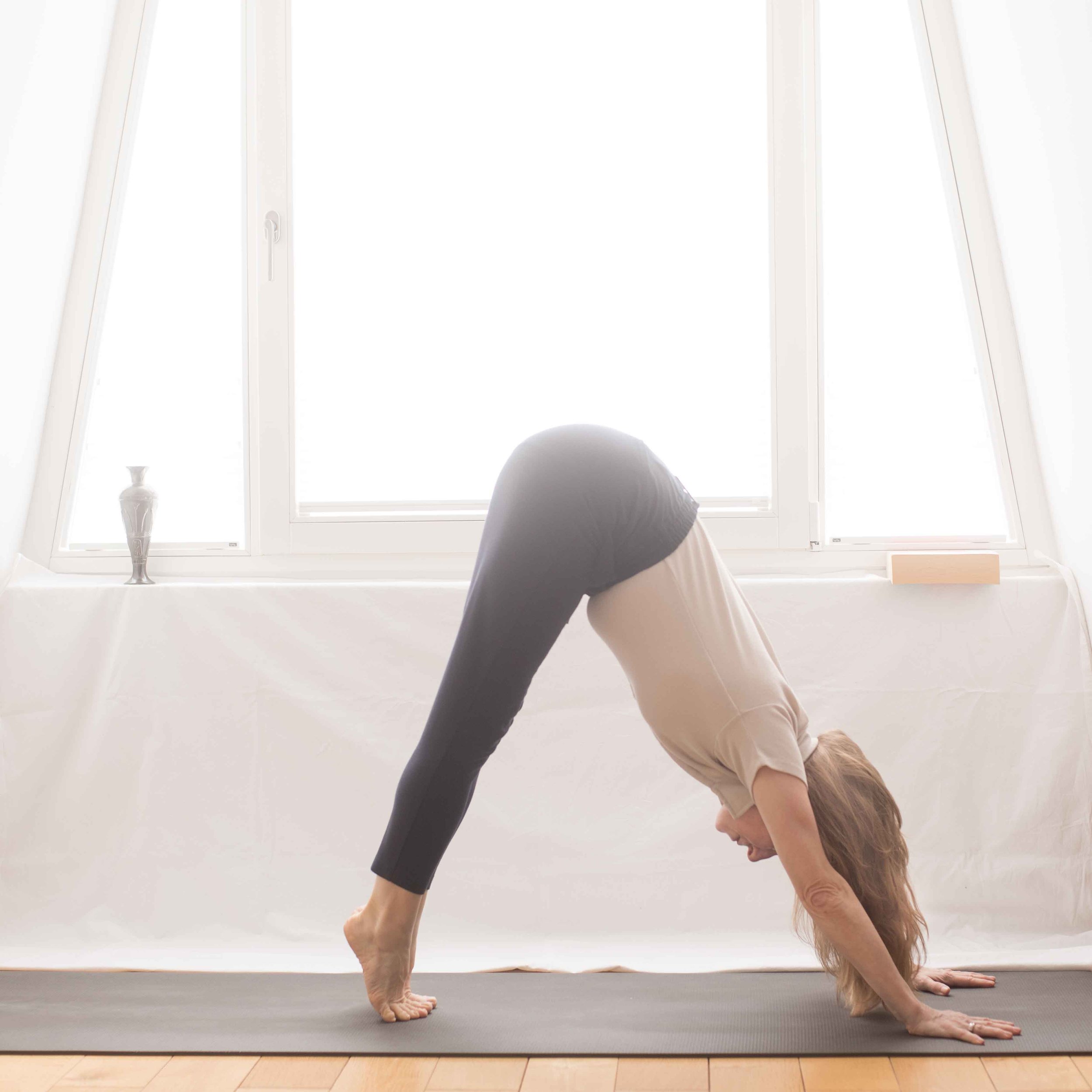
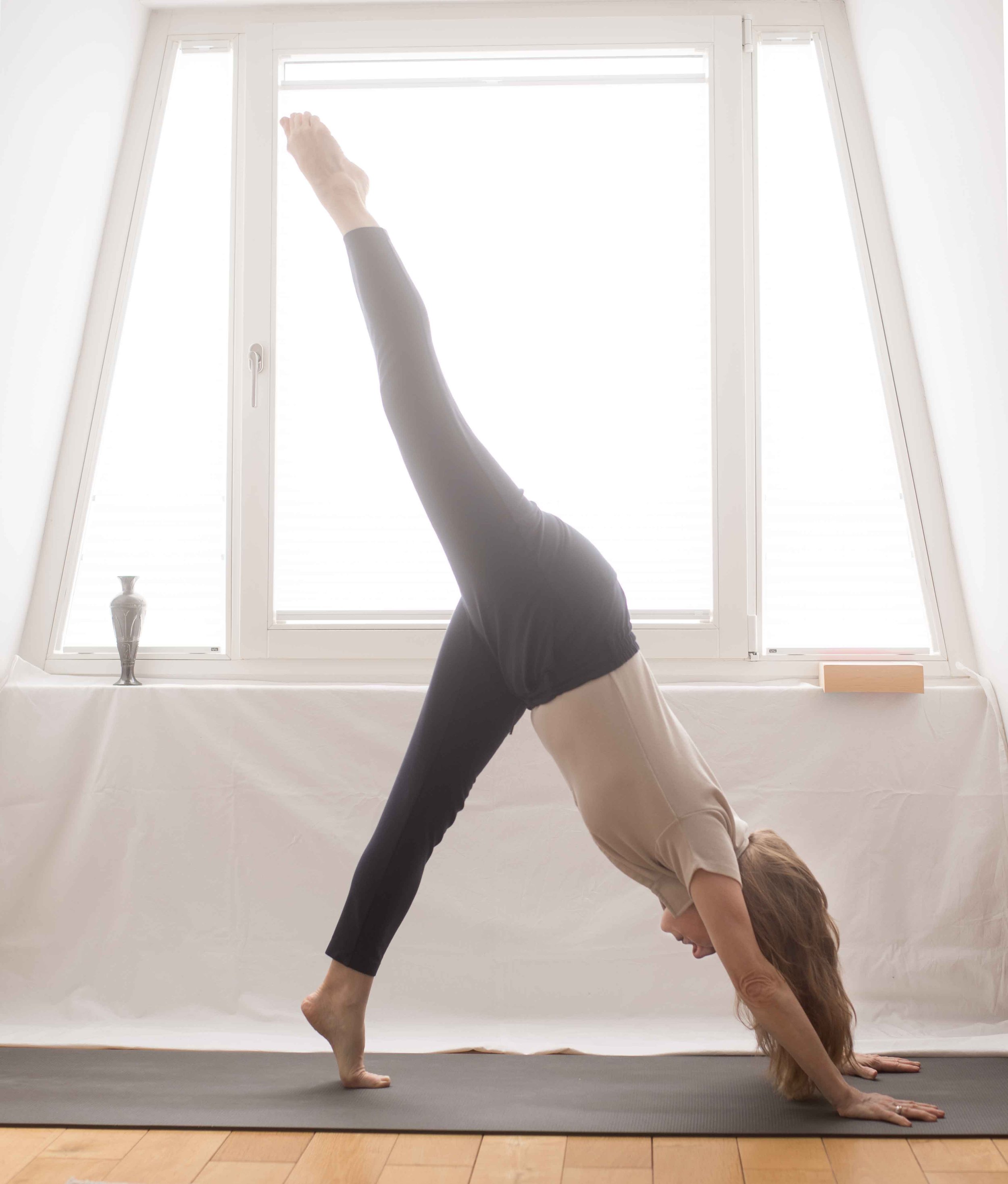
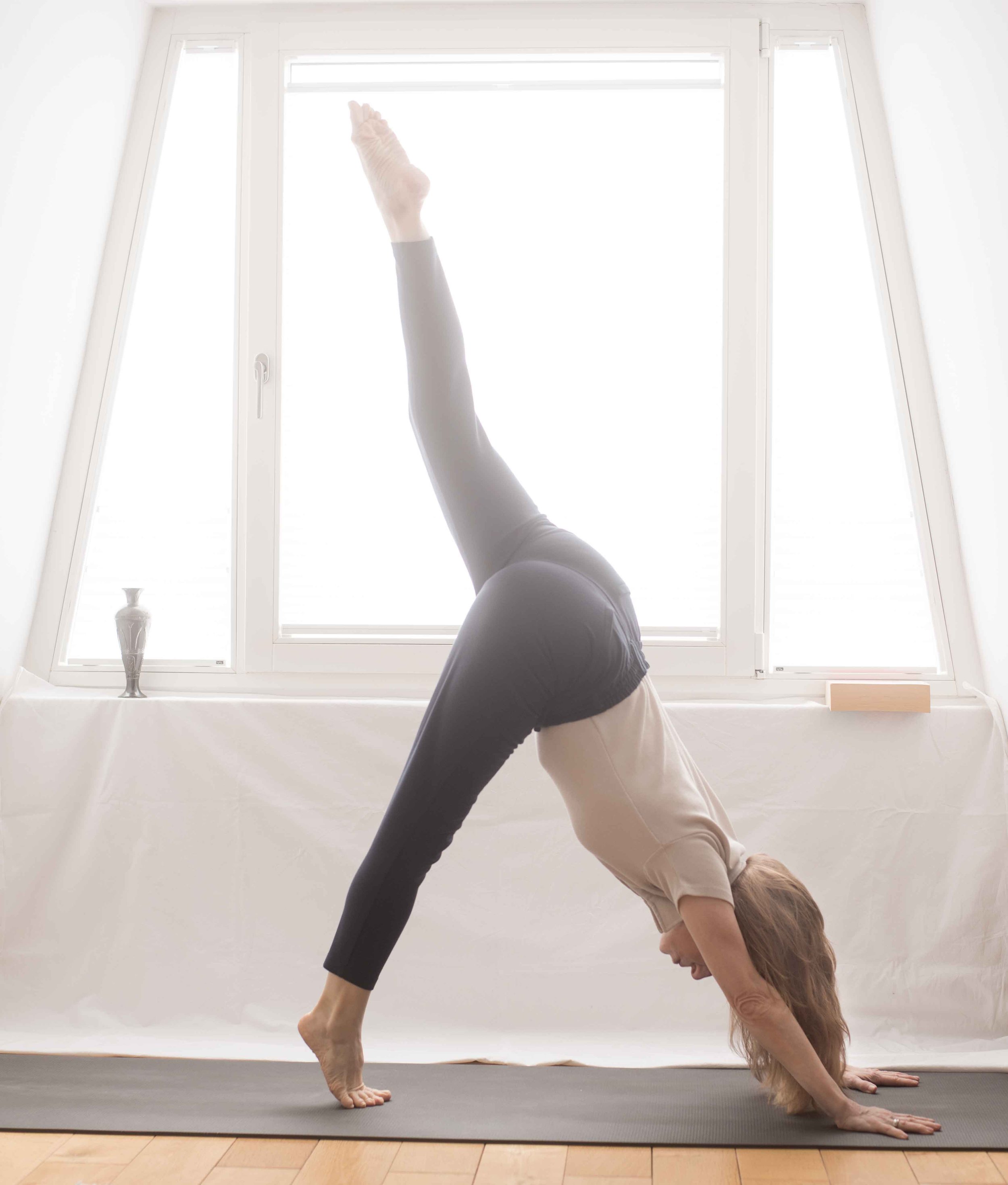
I practice the following exercise after sun salutations a or b. The goal is to stretch the hip flexor.
The exercise has a dynamic part and a static part. It starts after adho mukha svanasana. First I place the feet side by side without spacing. Then I raise the verses so that the weight of the body is on the hands and balls of the feet. Now comes the actual exercise. I swing the right leg stretched upwards. The feet are also stretched. The hips remain parallel if possible. I repeat this dynamic movement up to twelve times. I very often read that you should repeat dynamic exercise eight to 15 times. If you do even more repetitions, the exercise becomes an endurance exercise. Then change sides. More than three rounds are not necessary. At the end of the exercise you can hold the stretched leg. This completes the exercise.
The exercise warms up the body.
I don't necessarily feel this exercise is very intense. But it is a good introduction for what is to come.
Note on the side:
Hanumanasana (forward split) is an asana from the 3rd Ashtanga yoga series (Advanced A).
Samakonasana (side split) is an asana from the 4th Ashtanga yoga series (Advanced B).
Already the standing postures contain postures that prepare the splits. I am thinking of utthita hasta padangusthasana and utthita parsvasahita.
Translated with www.DeepL.com/Translator (free version)
The splits - where the journey begins
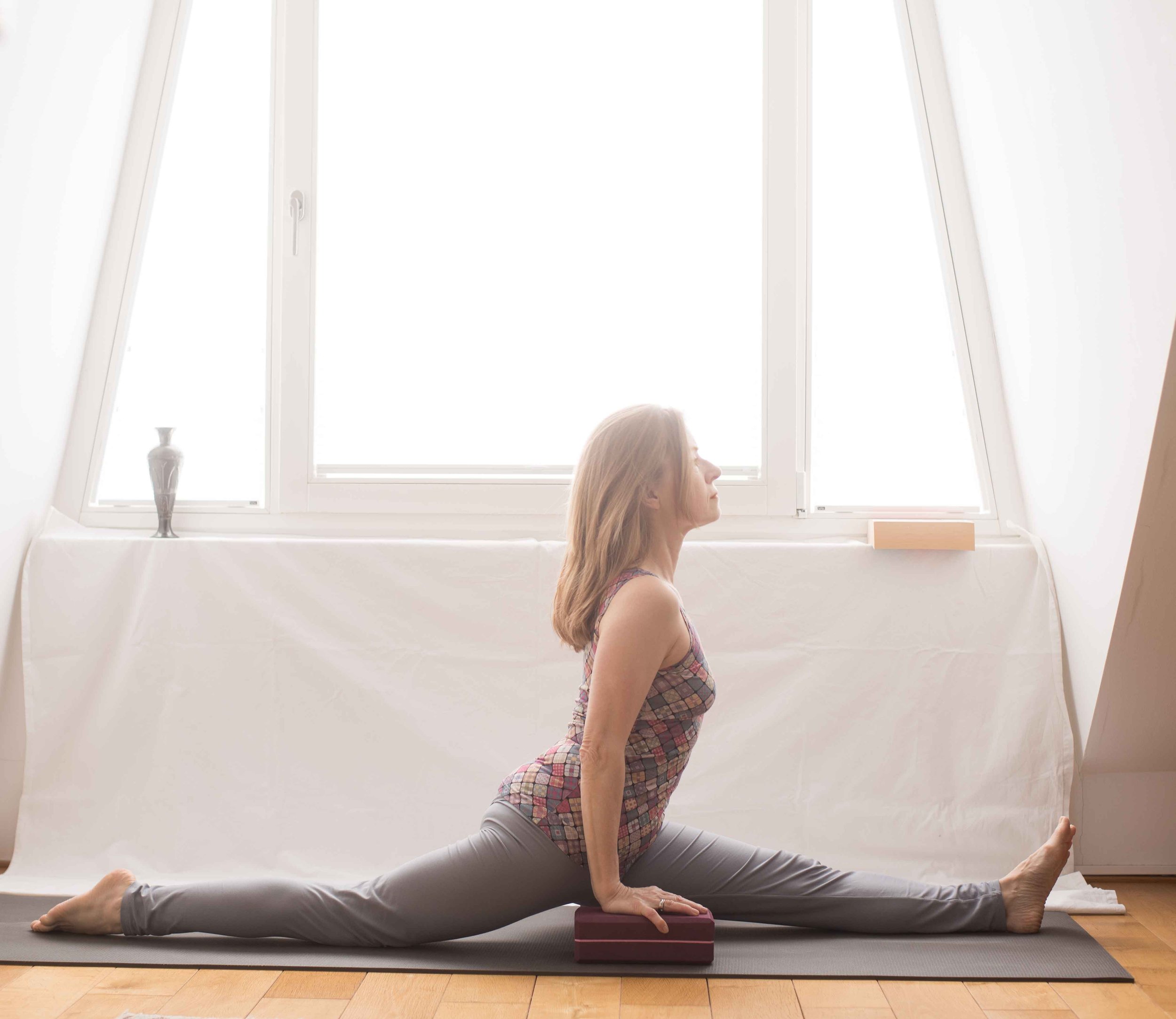
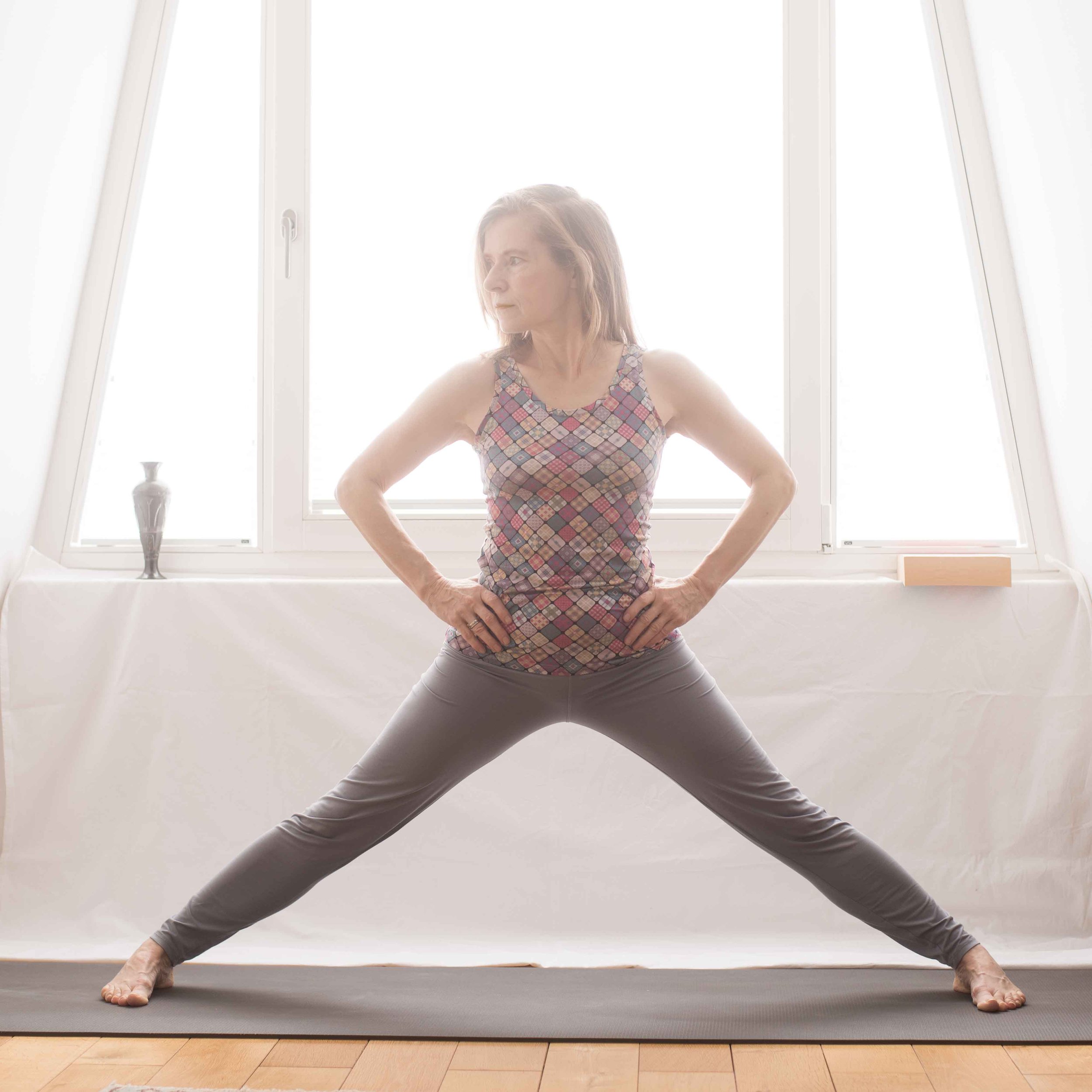
The journey can begin. The focus for the next few weeks will be the splits. At the end of May I will photograph hanumanasana and samakonasana again and compare them with today's pictures. I'm already curious to see if anything has changed.
Hanumanasana stretches the hip flexor and is a good preparation for backbends.
Samakonasana stands on its own. The important thing when doing this asana is to get into the hollow back. The legs are tense and move towards each other.
Tomorrow, the timer comes into play. I want to hold the splits for at least a minute.
What doesn't work:
Today I interrupted my exercise to take pictures. I screwed the camera on the tripod before starting my practice. So I was able to go right ahead and take pictures. Still, my practice was disruptively interrupted. I had to check if I was in the picture and if the pictures were also sharp.
If I want to continue my blog with pictures, I have to include a session where I create the pictures for the week.
Translated with www.DeepL.com/Translator (free version)
Consistency allows breaks

Integrating back bending, March 2023
Saturday is my day off.
I practice six days a week. One day a week is for recreation and all the other activities I want to do as well.
The next week I also focus on the splits again.
Asanas that you want to improve, you absolutely have to hold for longer than five breaths. Using a timer makes sense.
If you repeat challenging asanas up to three times, you usually notice progress. The pose becomes easier and often you are more flexible with each repetition. How to learn anything interests me. What do I want to learn and how do I want to learn it are important questions. I lost much time applying ineffective methods to learn things. With the internet learning anything can accelerate because so much useful information is available.
I will continue to use the following methods next week:
1. I’ll hold asanas for up to one minute or longer. This gives the opportunity to relax despite the pain of stretching. Deep regular breathing helps to relax. The pain subsides. One can then continue to stretch the body. It is important to tense the muscles during the stretch.
2. Repetitions are also very helpful. With each repetition, the position becomes easier. This is almost without exception.
First you have to think about what you want to focus on. Is it the backbends, twists, balancing poses?
Do you want to improve stretching, strength or technique?
What is the best way to practice? Which exercises are the most effective?
I will continue to document my journey. The practice yoga, yet the approach has changed over the last decade. Documenting the development is another tool to stay motivated and to improve. Pictures and movies show the truth. They help to reflect.
Tomorrow I will practice the 2nd Ashtanga series. I am integrating the splits exercises.
The splits are my new focus.

Hanumanasana, March 2023
Of course, I'm still practicing. However, I hardly ever go to yoga studios anymore. I find my teachers on YouTube. I learn from books. My pictures are always very helpful. Every hour on the mat is an opportunity to learn.
To diversify my practice I change the focus from time to time.
For the next few months, I will focus on splits (forward and sideways). There are very many variations. Hanumanasana stretches the hip flexor and hamstrings. This in turn helps improve the backbends.
The Ashtanga yoga series give me a sequence, but I change it as needed. I integrate exercises. Some postures I replace with easier versions or more difficult ones. I use a timer to hold challenging postures longer. Repetitions also help to get deeper into positions. Every day is different and an opportunity to explore your own possibilities.
Every Friday, in the Ashtanga tradition, we practice the first series. I also practice according to this. The 1st series means above all forward bends. Between the asanas I practice light backbends to make the series a little more balanced.
I wish everyone a lot of joy while practicing.
Translated with www.DeepL.com/Translator (free version)
A yoga community can be very supportive.


The asana in the pictures is the second asana of the October challenge by Carmen on Instagram (@cyogalife). Often the asanas are so advanced that I often practice and post simpler variations.
Mostly it is an intense experience to try out what is possible. Looking for boundaries and pushing them is an important process in everything you do.
The position in the third picture seemed impossible to me. I tried it. In the first picture you can see how far my hand was from my foot.
I posted a simpler variation of the asana and wrote: No way to reach the foot on the floor with my hand. I'm very content that I could lift one of my feet to the thighs.
A yogini (@newhope_bloom) who is also doing the challenge replied: Ursula, sure you will.
This motivated me to study my pictures again more closely. Maybe newhope_bloom is right and the position is possible for me as it was intended.
I saw on picture No1 that it should be possible for me to reduce the distance between foot and hand. For one thing, I could move the arm further back. On the other hand, I could raise the foot. Both changes do not yet require more intensive bending of the spine.
Thought - done.
It was possible to reach my foot with the hand.
Often more is possible than we think. At the first attempt one does not immediately reach ones possibilities.
Pictures always help to improve and to discover mistakes.
In addition, it can be very supportive to be part of a yoga community. It is inspiring and motivating at the same time.
Translated with www.DeepL.com/Translator (free version)
Migraine


Last night these unbearable headaches already started. At first everything was still halfway bearable. At some point I took the first aspirin and later the second. They did not really help well. I rolled around in bed as I lay down to sleep. Lying still was impossible. Impatiently I waited for the morning. At 4:30 a.m. I got up. Sitting up made me feel better. But sitting through the night was also too exhausting for me.
After a few hours I felt better. It was already light when I went to bed again and slept a round. It was the sleep of exhaustion.
When I finally got up, I didn't want to practice yoga with all the vinyasa. I was afraid the migraine would return.
Instead, I went for a walk. Soon I bumped into all the Wiesn visitors. Today was the last day of the Volksfest. I don't want to know how many of them got another good headache today. Such a beer intoxication is also not without.
It is the beginning of October it begins not only a new month, but also the last quarter of 2022. My zeal has got a damper by the headache.
Still, I managed to photograph the first three postures of the October challenge in the afternoon. The community around Carmen on Instagram @cyoglife is very nice. In October, the scorpion is the theme. Carmen has prepared a position for each day, most of which are very challenging.The yogis have again posted their versions of the asanas on Instagram. It is a pleasure to go through the pictures.
My personal theme for October is the vinyasa. All of them.
The backbends will continue to be practiced. My focus is shifting for a time. Vinyasa also always means practicing on strength. This will be good for me.
.
Have a good start into October.
Keep practicing. Keep practicing.
Translated with www.DeepL.com/Translator (free version)
Yoga on the road

Shoulder stretch, September 2022
Yoga on the road:
So far I haven't found a really good solution how to maintain a daily yoga routine while traveling. I often follow the routines of the people around me. Meeting them is one reason for traveling. There is usually more eating in a group. There are more meals that are celebrated. Breakfast, lunch, coffee and cake, and dinner are too much for a yogi with a frugal lifestyle. That's just how visits go. People meet to talk and eat together. You go on outings and create memories together. It's all fun, but the 90 minutes of yoga in the morning are often sacrificed. I know that there are yogis who always practice no matter what is happening around them or where they are. They are a role model for me.
It takes a lot of energy to swim against the current. It's really exhausting to escape the peer pressure. Often you make a bad impression when you withdraw. Nevertheless, I repeatedly succeed in practicing. Nevertheless, when I travel, my yoga practice remains sporadic. I would like to add 'yet'.
On the last trip, last week I had at least warm clothes with me, so the cold was no reason not to practice. At home, I can do it warm. When you are on a visit or in hotels, that just often doesn't go. It can also be a challenge to find a suitable place to unroll the mat. Last week I managed to do some gravity training in the evening. Just turning on the videos and being guided through the exercises is really easy. This way I didn't miss breakfast together and still did something for myself.
I am working on solutions. How do you manage to practice yoga while traveling, preferably in the morning before breakfast:
- Having warm clothes with me so I can practice when it is colder is part of the solution.
- Skipping breakfast and practicing instead seems doable to me.
- A shorter practice time of 30 minutes is easier to squeeze into the daily routine than 90 minutes. Settling for less than usual can be part of the solution.
- And you have to be stubborn. There doesn't have to be an alternative mentally to daily exercise. The more the environment is set up for it, the easier it is.
When you travel, you practice flexibility. You experience new things and experience yourself in a new way. I would not like to do without travel. I would like to continue to visit people. But I understand why some yogis become hermits.
Arriving back home is also nice.
Tonight I will practice the gravity training from Lucas and tomorrow morning the first thing on my list is 90 minutes of Ashtanga Yoga. The morning routine can now run again exactly as I designed it. What a luxury.
Feel free to share your tips and tricks on how to practice yoga while traveling.
Maybe you noticed that I found a translation software. DeepL is its name and I am thrilled. From now on my blog posts will be error free........ Wow.
Translated with www.DeepL.com/Translator (free version)
Develop a long breath.

Core training, Sept 2011
A good workout is balanced. This is how you protect yourself from injuries. After intensive backbends, it is recommended to bend forward as well. It makes sense to strengthen both the back and abdominal muscles. This protects the spine.
I sometimes try to incorporate strength exercises into the yoga practice.
The picture shows how I try to reach the feet with my hands. The abdomen must be tensed to move the upper body away from the floor. Twelve repetitions is a good start. You can increase until it becomes strenuous.
The main thing is to do something.
Just the other day I had a conversation with someone who told me how difficult it is to even get started. This is where the exercise starts. You get to know yourself by finding out what motivates you and what keeps you from doing something. You learn to deal with yourself, with your mind and with your body.
No matter what you want to become good at, you need to have staying power and learn to deal with frustration. But the path to more knowledge and skills also holds many joys. It is worthwhile to be patient and keep going. In this sense I wish you a good yoga week. For me it starts again on Sunday. Saturday is a day off.
Translated with www.DeepL.com/Translator (free version)
Three days with Danny Paradise
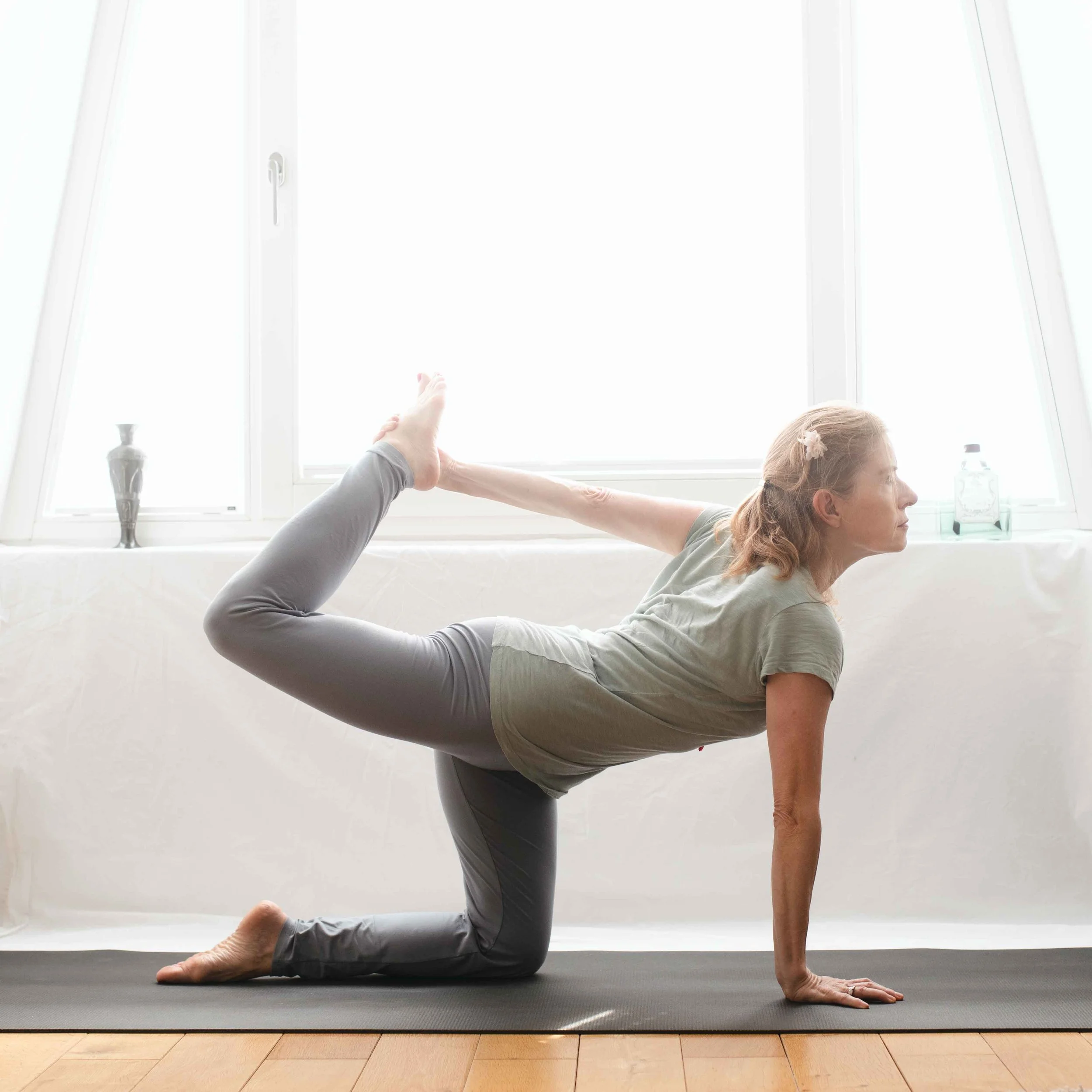
Back bending, August 2022
The last three days were very exciting. I had the opportunity to be part of a workshop with Danny Paradise. Every day we practiced pranayama and asanas in a group of about 12 people.
The Ashtanga community is rather drifting to a more regulated and strict practice, while Danny blends different sources and styles. We exercised martial art techniques, Egyptian forms and classic Ashtanga Yoga asanas from all the series. One could feel the free spirit, the creativity, the attentiveness and energy.
When Hundreds of students come together individual teaching is no more possible. So I absolutely understand that there must be clear rules in order to teach the masses.
To get individual instructions is a luxury these days. Individual training allows to break the rules, to move away from what everybody does to a more free practice.
You learn from the teacher and then it’s your own practice and knowledge, Danny said. No ‘guru’ is necessary. Who is a guru anyway?
The asana practice looked like I practice at home these days. The series are the skeleton. I add asanas when I want to. Sometimes they are easier than the classic one, sometimes more difficult.
Every day one has to approach the practice with attentiveness. Every day is different. Nobody can repeat what was yesterday.
The 90 minutes of pranayama on two days were great. We learned different breathing techniques.
Here is a link that I found on YouTube. The video with Danny Paradise is recorded during a conference in Bali in 2013. It lasts 2 hours and it’s absolutely worth watching.
Counter poses after back bending.
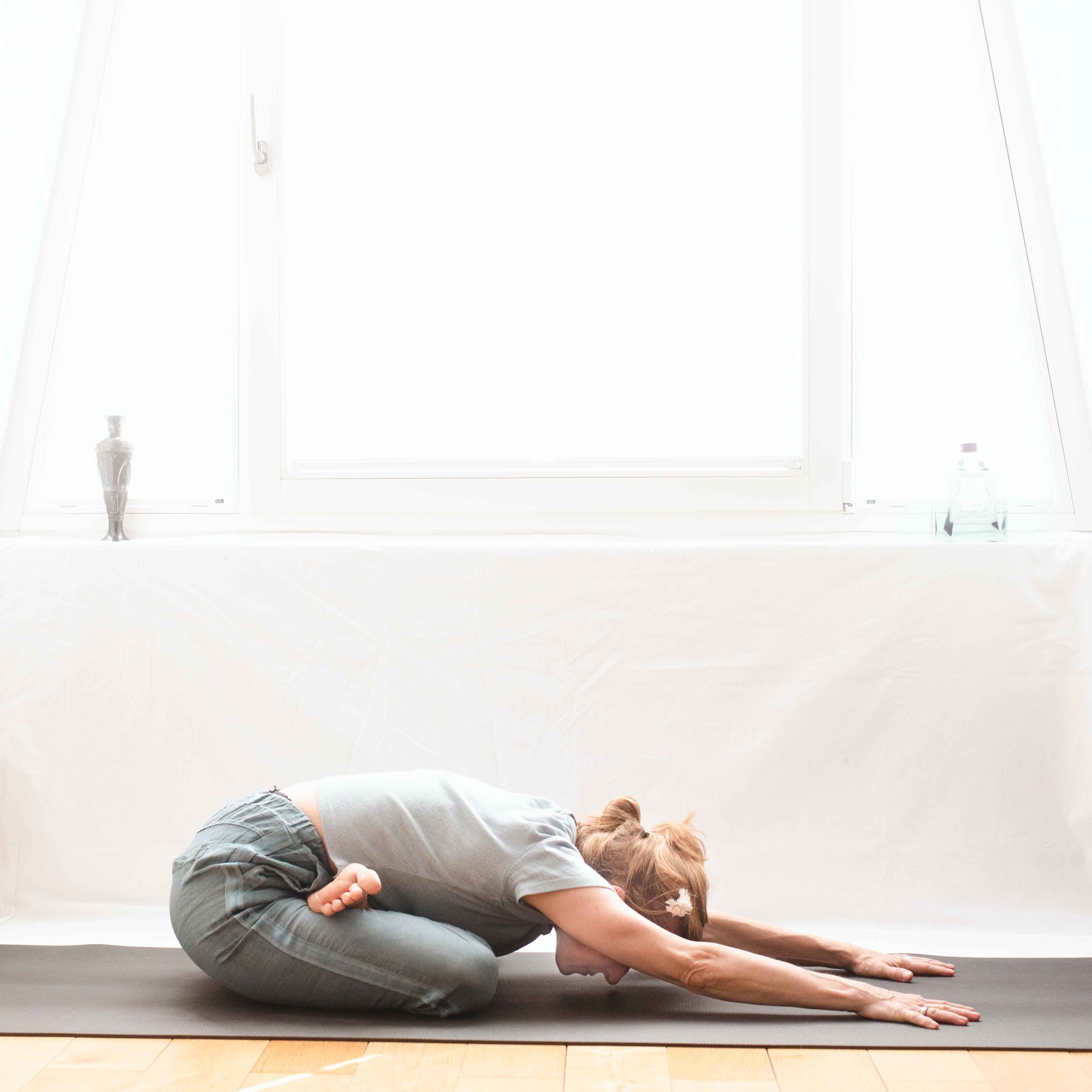
Forward bending asana, September 2022
On Sundays, Mondays, Tuesdays and Thursdays I focus on back bending. The last practices were rather intensive. On Tuesday I realised that my sacroiliac joint was not so content. I felt a slight discomfort. I had to take care not to do the tiniest awkward asana.
Today I practiced forward bending asanas. And all seemed OK again. The body needs balance.
For me it’s good advise to practice forward bending asanas after having exercised deep back bending asanas. It relaxes the back. It balances the entire practice. It’s not about bending backward for 90 minutes.
Twists and forward bending asanas relax the spine again after deep back bending asanas.
I’ll take care of this even more from now on. If one is attentive, the body gives messages.
To practice primary Ashtanga on Wednesdays and Fridays seems to be very good. The body needs time to integrate new movements. It counter balances the days on which I focus on back bending.
It’s not about progressing as fast as possible. I want to avoid injuries.
Working on the core muscles also protects the back.
Counter poses are not boring. They can be very relaxing.
Paschimottanasana after urdhva dhanurasana was often too much for me as a counter movement. The back hurt. These days I move slowly into forward bending asanas.
Hanging forward is great. Baby pose is great. Also a simple squat pose helps to relax the back again. After these easier forward bending asanas my body is ready for paschimottanasana.
I learn to protect myself.
Take care.
Don't be a lazy yogi.

Back bending, September 2022
With each attempt this pose got better.
I struggled with the pose and with the camera. First I used my phone. The results were not convincing. Then I used again my camera. I feared not having enough distance from camera to where I performed the asana. Yet it was possible.
At the place where I usually take the picture I don’t have a wall. For this exercise a wall was necessary. It’s another asana of the September challenge with Carmen ( cyogalife ) on Instagram. I show on my blog only the back bending asanas, because I focus on back bending in September.
Carmen’s challenge is a good opportunity to try out new poses and to have fun with the yoga community.
Every time I exercise back bending the body gets a tiny bit more used to the movement.
Today I realised again how important it is to have a reasonable didactic to learn back bending. It’s not just doing it. It’s often a waste of time and one risks injuries. To have the goal to learn urdhva dhanurasana for instance is great. Yet how to get there is an important question. Just do it and one day you’ll be there is not enough. Perhaps you’ll be able to master this pose in your next life I even heard once. Progress must be seen faster. I’m convinced it is.
Sometimes one has to step back to have a closer look at one’s own exercises. A critical view is necessary.
Having watched the course with Ugi, a contortionist, on Omstars accelerated my progress enormously. I feel how the exercises help. And it feels save what I’m doing. Sometimes it’s worth to spend money to get advise from the real experts. Yeah it’s difficult to find out who is truly informed. Many think they know everything, but do they?
Picture: This morning I read that the butt is supposed to be on the wall. This would have been possible. I’ll try it next time.
Back bending - the upper body.
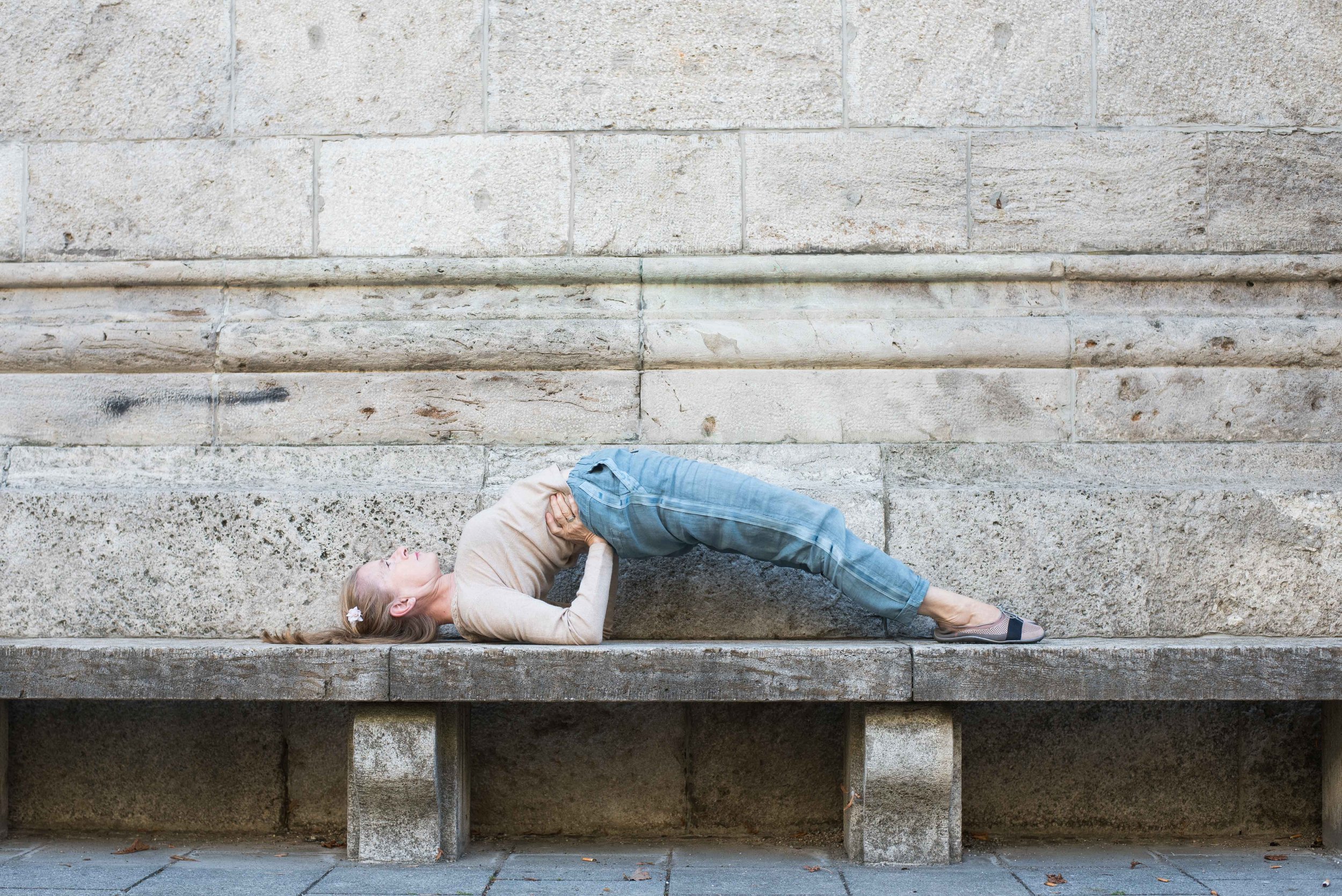
Back bending, September 2022
There are four obvious parts of the body that need to get stretched when doing back bending:
The thighs.
The hip flexors.
The upper body.
The shoulders and arms.
(Of course the entire body is involved when practicing asanas but it’s possible to focus on special areas.)
To exercise certain muscles isolated is not so overwhelming like exercising the entire body together. It helps to deepen the understanding of an asana. It’s effective. It’s possible to adjust the exercises to one owns need. Some have flexible arms, others are stiff there. Most people have stiff hip flexors, but there are also people who are very flexible, but lack strength for instance. There are the ambitious and the talented. It’s good advice to individualise the training.
In the above picture I stretched my legs. I pushed the feet into the ground to push the upper body towards the head. This is a relative easy stretch. This exercise gives the body the opportunity to get used to this sort of stretching. The hands support the back and the movement.
More challenging asanas will come.
I usually integrate exercises in my morning practice.
Stretching takes time and patience. Every injury means a set back. Consistency is the key.
Don't be obsessed with super advanced asanas.
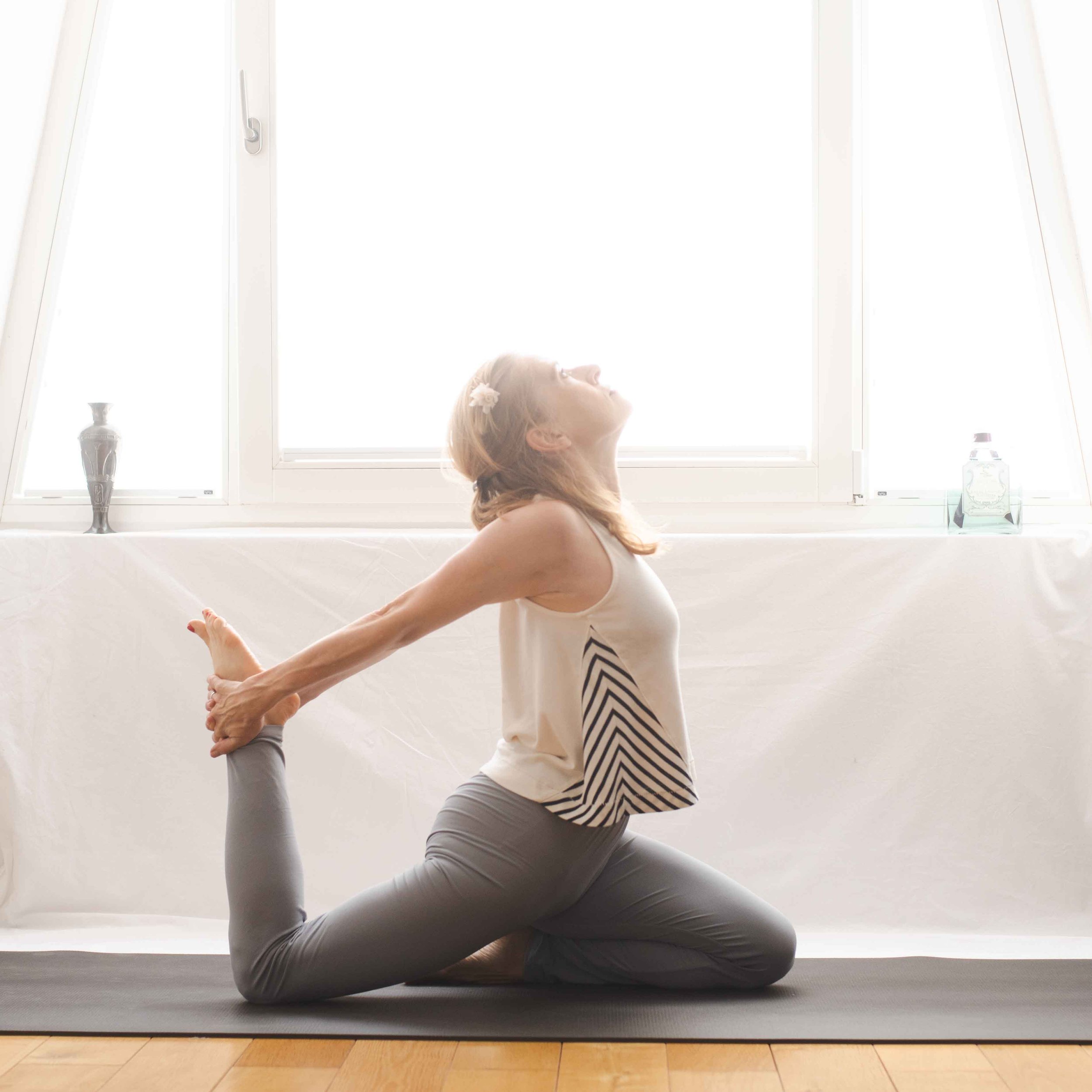
A variation of eka pada raja kapotasana, September 2022.
I joined again a challenge on Instagram created by Carmen (cyogalife) from Hawai. She is an advanced student and very creative. Her asanas surprise me again and again. I often chose to go for an easier variation I don’t like to risk an injury. I love to explore new asanas, but I don’t want to injure myself. I know my current flexibility level. To reach the foot with the arms stretched over the head is not doable. I also cannot flip the grip.
I’m working on stretching the shoulders and the front side of the body. Perhaps in a couple of months I’ll try this pose again.
It’s a lot of fun to be part of this yoga community around Carmen who all strive to learn asanas, the crazier the better.
Again and again one must try out new things. Otherwise one doesn’t know the own limits and the own possibilities. I’m looking forward to the next few asanas.
Back bending - stretching the hip flexors
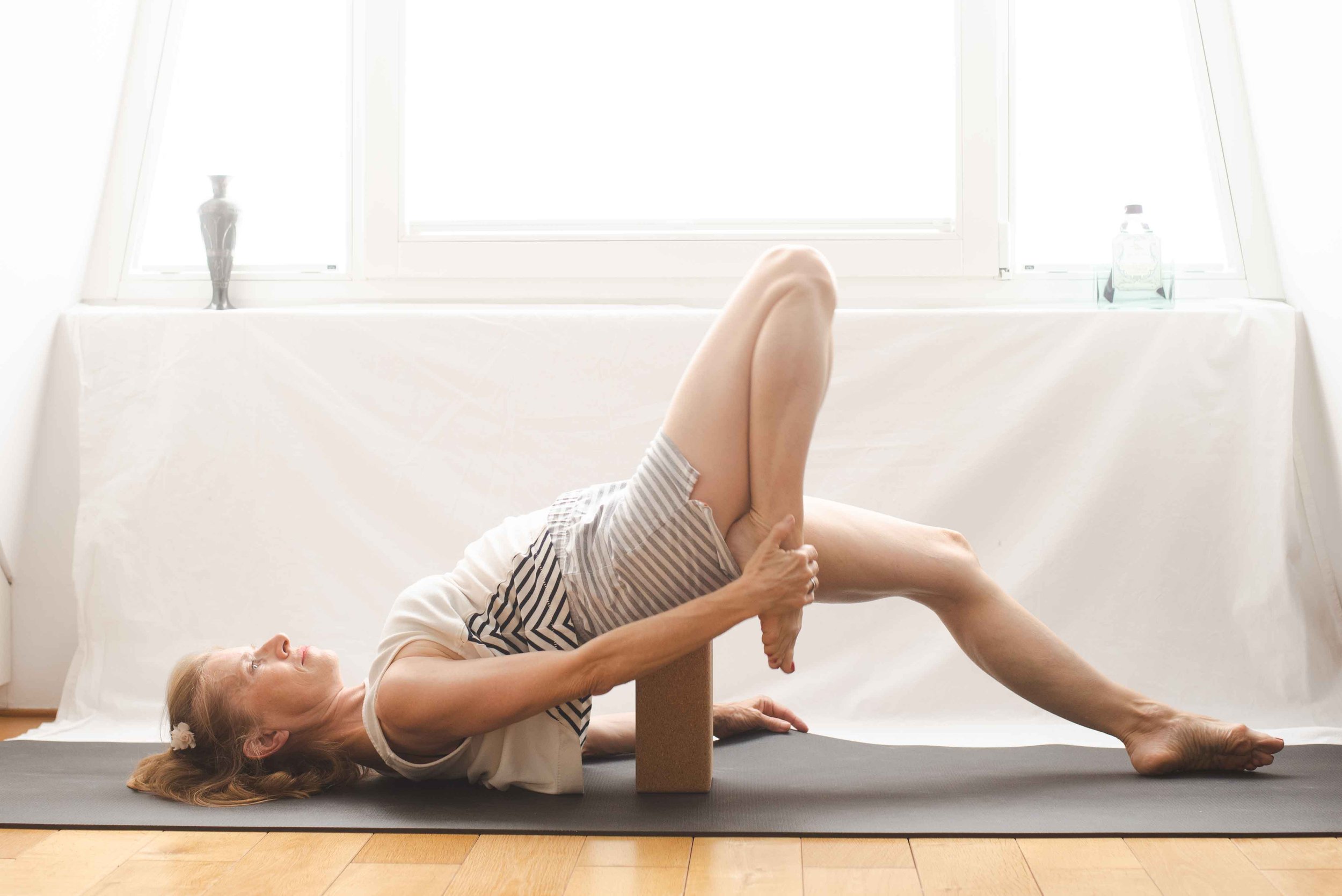
Back bending, Sept 2022
I put a block under the sacrum and stretched both legs. The goal was to stretch the hip flexors. Muscles stretch when they are relaxed. A deep and even breath supports that the muscles and the entire body relax.
It takes time till the maximum stretch is reached. After a while I could go deeper. Then I added variations. I stretched one leg to the ceiling. Then I changed the leg.
I also moved the feet backwards. It’s a deep stretch of the thigh and the hip flexor. My pictures told me that the upper legs were no more at the same level like the stretched leg. The bent leg was much higher. It didn’t feel like this. I moved the foot further backwards. This intensified the stretch.
With one leg bent, I realised that the shoulders lifted up from the floor as well. This is a sign that this exercise has still potential. Gravity helps in this position. The trick is to hold this pose long enough to get results. Two minutes up to five minutes will be good.
Next time I try the exercise with a towel or a soft cushion on the block.
When I started my yoga practice today, I felt stiff. Don’t expect too much today, I thought. I started slow and took it easy. Very soon my body become softer and stronger. The practice became so wonderful.
Practice with the body not against it.
Back bending positions hide everywhere.
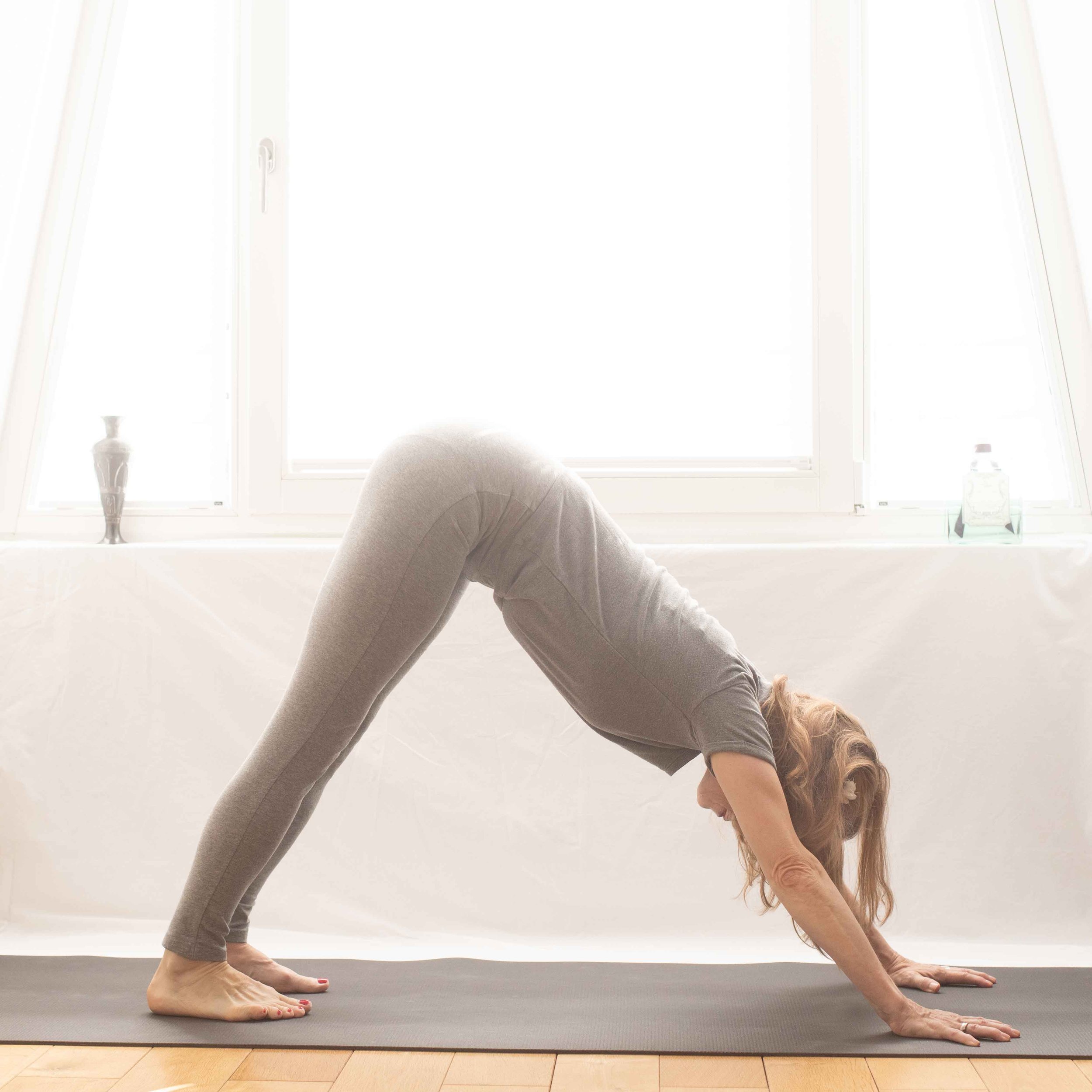
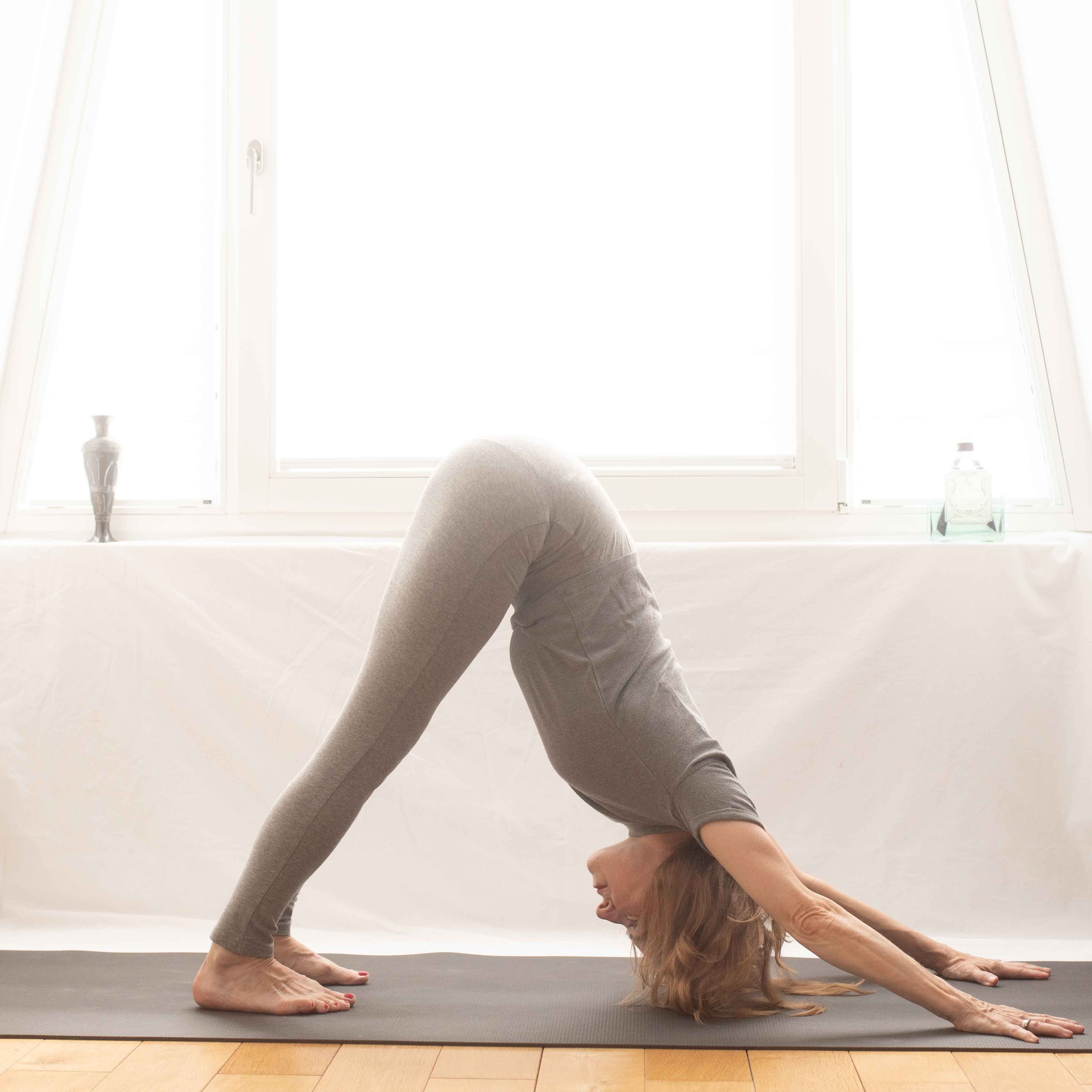
A classic downward facing dog (adho mukha svanasana) looks like a pyramid.
In order to get a stretch for the shoulders and upper back one can move the head to the floor. To squeeze the shoulder blades supports the process.
I start with a dynamic phase and swing the upper body in direction to the legs. The head gets closer to the floor. After 12 times I stay in the position and try to get even a bit deeper.
This looks not very dramatic when I’m doing it.
That’s why I do these exercises.